
Table of Contents
For years, ranking content on Google felt like a simple math problem. You found a popular phrase, put it in your headings a few times, built some links, and waited for the traffic to roll in.
That approach is dead.Search Intent vs Keywords: What Actually Helps in SEO Rankings in 2026?
If you still build your content around exact-match phrases without looking at what the searcher actually wants, your pages will struggle to get noticed. The debate around search intent vs keywords SEO isn’t about choosing one over the other—it is about understanding which one actually drives modern search engines to recommend your site.
Here is a look at how search rankings actually work right now, why user goals matter more than raw search terms, and how to adapt your strategy to grow your business.
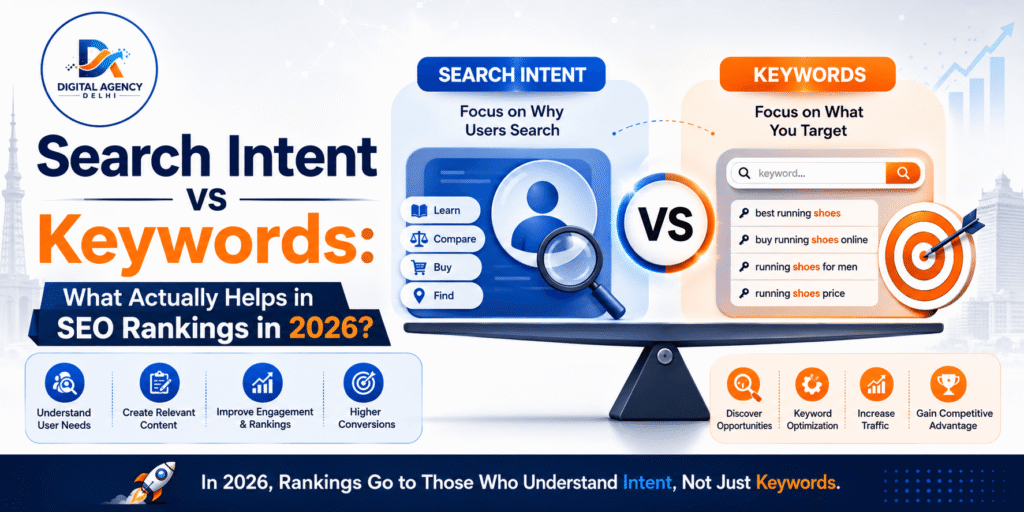
Keywords vs User Intent: Understanding the Shift
To understand why search intent matters more than keywords, you have to look at how search engines read web pages today.
Keywords are simply the words someone types into a search box. Intent is the underlying problem they are trying to solve.
- The Old Way: A user searches for “best CRM for small business.” An old-school campaign targets the phrase 15 times on a page filled with generic product descriptions.
- The Modern Way: Google realizes the user wants a comparison table, pricing details, and quick integration guides. Pages that offer direct, structured answers win top placement—even if they barely repeat the exact search phrase.
Does this mean keywords are useless? No. The role of keywords in modern SEO has evolved. Today, keywords act as topics and contextual clues. They tell search engines what core subject you are addressing, while your content quality and structure prove whether you actually answer the query.
Key SEO Ranking Factors in 2026
Search algorithms no longer just index text; they synthesize answers. Here is what is driving traffic today:
1. Intent Satisfaction
If a user lands on your page and immediately bounces back to search results, you lost. Google tracks whether your page gives searchers the exact format, depth, and answer they expected.
2. Generative Engine Optimization (GEO)
AI-driven search engines pull summary answers directly from authoritative sources. To be cited in these summaries, your content must use clear headings, direct answers, simple tables, and verified facts.
3. Topical Authority
Search engines favor websites that cover a topic completely rather than sites publishing one-off articles packed with keywords.
Understanding these SEO ranking factors in 2026 is the baseline for modern organic growth.
Turning Intent into Revenue: Why Execution Matters
Knowing the difference between keywords and intent is easy on paper. Executing it across dozens of commercial landing pages is where most businesses struggle.
If you run a local enterprise or a growing service brand, matching intent requires careful research, content restructuring, and technical accuracy. For example, a commercial query like “hire web developer” needs transparent pricing signals, case studies, and clear contact forms—not a 2,000-word essay on the history of coding.
This is where working with an experienced partner pays off. Digital Agency Delhi helps brands bridge the gap between technical search standards and real audience needs.
As a leading SEO company in Delhi, the team focuses on intent-driven strategies that turn search visibility into actual leads. Instead of chasing vanity metrics, an established SEO agency in Delhi audits your target audience, analyzes competitors, and structures your site to match what your buyers are actually searching for.
Whether you need tailored SEO services Delhi or dedicated guidance from an SEO expert in Delhi, aligning your site structure with real search intent is the fastest path to sustainable rankings.
Frequently Asked Questions
Can I still rank without using exact keywords?
Yes. Search engines use natural language processing to understand synonyms and topic clusters. While using relevant terms naturally is important, answering the user’s explicit question matters far more than matching exact phrase variations.
How do I find the search intent behind a keyword?
Type the keyword into Google and examine the top five results. If the top pages are all step-by-step guides, the intent is informational. if they are product landing pages, the intent is transactional. Match your content format to what is already working.
What is Generative Engine Optimization (GEO)?
GEO is the process of optimizing content so AI tools and generative search engines easily digest, quote, and source your pages in their automated answers.
Why hire a local SEO partner like Digital Agency Delhi?
Local search dynamics require specific geographic targeting alongside global intent matching. Working with the best SEO agency in Delhi ensures your business captures high-intent regional traffic while building long-term domain authority.
Ready to Upgrade Your Search Strategy?
Chasing outdated keyword metrics will keep your site stuck on page two. To win competitive search results today, you need a strategy built around user intent, clean site architecture, and modern optimization standards.
If you are ready to build an organic growth engine that converts visitors into customers, reach out to Digital Agency Delhi. Known as a top-rated best SEO company in Delhi, our team delivers intent-driven campaigns tailored to your business goals.
Contact Digital Agency Delhi today to request a complete SEO and content intent audit.
