

Table of Contents
Google Search is changing quickly. For years, businesses have built their SEO strategies around a familiar process: someone types a keyword into Google, scans the results, clicks a website and continues researching.Google AI Mode and the Future of SEO
That process is becoming more conversational.
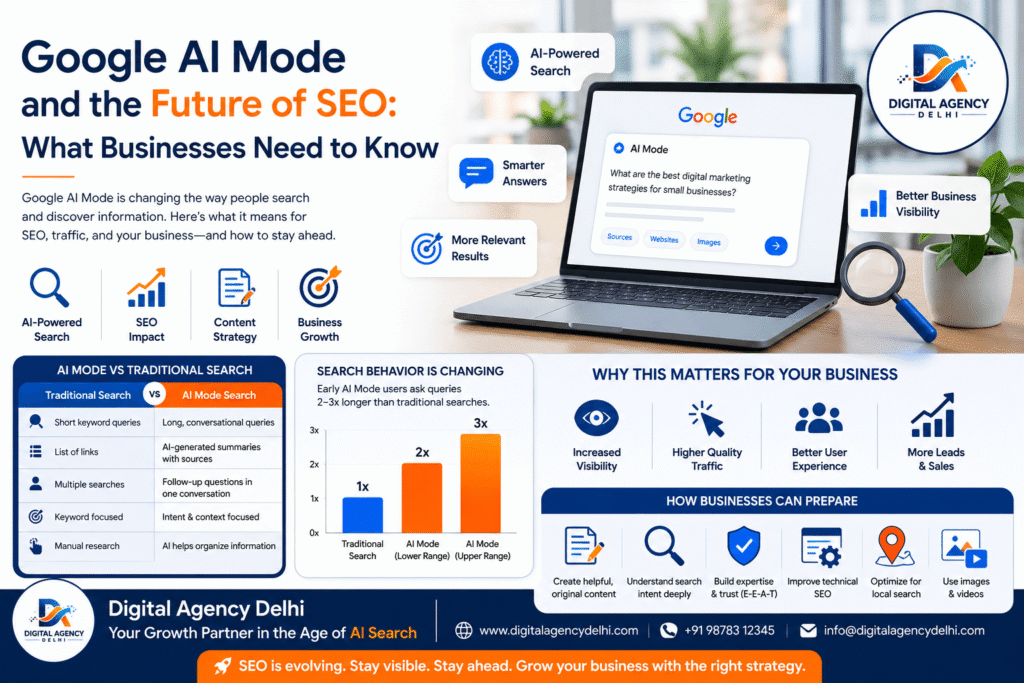
Google AI Mode allows people to ask longer, more detailed questions and continue the conversation with follow-up searches. Google says early AI Mode users were asking queries around two to three times longer than traditional searches, showing how search behavior can change when people are given a more conversational interface.
For businesses, this creates an important question:
If Google can answer more of a customer’s question directly, what happens to SEO?
The answer is not that SEO is dead. In fact, Google says its established SEO best practices remain relevant to AI search because AI experiences are built on Google’s core Search ranking and quality systems.
What is changing is the way businesses need to think about visibility.
Ranking for one keyword is no longer the entire story. Businesses need to create content that answers real questions, demonstrates expertise, provides useful information and gives people a reason to visit the website.
This article explains what Google AI Mode means for SEO, how businesses can prepare, and where an investment in SEO and AI search optimization may make sense
What Is Google AI Mode?
Google AI Mode is an AI-powered search experience designed for more complex and conversational questions.
Instead of searching several times to research a topic, users can ask Google a detailed question and then continue with follow-up questions. Google describes AI Mode as an experience that combines advanced AI reasoning with Search and links to information across the web.
For example, a traditional search might look like:
“Best SEO agency in Delhi”
A more conversational AI Mode search could be:
“I own a small business in Delhi and want more customers from Google. Should I invest in local SEO, Google Ads, or social media marketing, and what should I consider before choosing an agency?”
The second query contains multiple questions.
The user may want to understand:
- Which marketing channel is suitable
- What SEO involves
- How local visibility works
- What an agency actually does
- What factors affect cost
- Which option could generate leads
This is where the Google AI Mode search experience becomes important for businesses.
Google has also expanded AI Mode beyond simple text searches. In India, AI Mode has supported text, voice and image-based interactions, and Google has continued expanding multimodal and conversational capabilities.
Google AI Mode Search Behavior at a Glance
Google reported that early AI Mode users were asking questions around 2–3 times longer than traditional searches. This is not a ranking metric; it is an indication of how the search experience can encourage more detailed queries.
For marketers, this is a useful signal: customers may increasingly express their needs through complete questions rather than short keyword phrases.
How Is Google AI Mode Different From Traditional Google Search?
Traditional search usually starts with a keyword.
AI search can start with a conversation.
That difference may sound small, but it can influence how people discover information.
Consider someone searching for a laptop.
With traditional search, they might search:
“Best laptop for video editing under ₹60,000.”
Then they may search:
“Best laptop for Premiere Pro.”
Then:
“Laptop RAM for video editing.”
With an AI-powered search experience, they can potentially combine these requirements into one detailed question and then ask follow-up questions.
The search journey becomes less fragmented.
| Traditional Search | Google AI Mode |
|---|---|
| Often starts with a short keyword | Can begin with a detailed question |
| User reviews separate search results | User can receive a synthesized response |
| Multiple searches may be needed | Follow-up questions can continue the same conversation |
| Keywords often dominate planning | Search intent and context become more important |
| User may compare many pages manually | AI can help organize information |
| Website click is often the next step | User may explore an answer before clicking |
This does not mean websites are no longer important.
Google’s current guidance says AI search experiences use content from its Search index and continue to rely on core Search systems.
For businesses, the opportunity is to become a useful source within this broader search journey.
How Google AI Mode and SEO Are Connected
The relationship between Google AI Mode and SEO is closer than many businesses realize.
Google’s official documentation says SEO remains relevant for generative AI search because these experiences are rooted in Google’s existing ranking and quality systems. Google also explains that its AI experiences can use relevant pages from the Search index to ground responses.
That means the basics still matter.
Your website should be:
- Crawlable
- Indexable
- Technically accessible
- Useful to visitors
- Relevant to search intent
- Easy to understand
- Supported by trustworthy information
This is an important point because some businesses are treating AI search as if it requires a completely separate form of SEO.
It doesn’t.
You should think of AI search as another reason to improve the quality of the website you already have.
A website with weak content, technical problems and little expertise will not suddenly become valuable because it adds the phrase “AI SEO” to its pages.
A website that genuinely answers customer questions has a much stronger foundation.
The Impact of Google AI Mode on SEO
The impact of Google AI Mode on SEO will vary depending on the business, industry and type of search.
A local plumber, an online retailer and a B2B software company will not experience AI search in exactly the same way.
However, several areas deserve attention.
1. Organic Visibility May Become Broader
SEO visibility has traditionally focused heavily on rankings.
But businesses now have another question:
Where does my brand appear when customers ask Google a detailed question about my industry?
Google is developing more ways to understand visibility within its generative AI experiences. In June 2026, Google announced dedicated Search Console reports for visibility in generative AI features such as AI Overviews and AI Mode, initially rolling them out to a subset of websites.
This is an important development because measurement is essential.
Businesses cannot improve what they never monitor.
2. Click Behavior May Change
If Google provides more information directly in the search experience, users may not click every result.
But that does not mean every AI search becomes a zero-click search.
Some questions can be answered quickly.
Other searches require deeper research.
Commercial searches are especially interesting because customers often need more than basic information before making a purchase.
Someone choosing an SEO agency may want to compare:
- Services
- Pricing
- Experience
- Reviews
- Case studies
- Industry expertise
- Locations
- Expected outcomes
A website can still play a major role in that process.
3. Search Queries May Become More Detailed
Longer questions give Google more context.
Instead of targeting only:
“digital marketing agency”
a business may need to understand searches such as:
“What digital marketing strategy should a small local business use to generate more leads?”
This is why AI search and SEO are increasingly connected to search intent.
The content that wins attention may not simply contain the exact keyword.
It needs to address the underlying problem.
How AI Is Changing SEO for Businesses
The question of how AI is changing SEO goes beyond rankings.
It is changing the way marketers should plan content.
Search Intent Matters More
Imagine a user searches:
“SEO agency cost.”
They probably don’t want a dictionary definition of SEO.
They want to know what they are paying for.
A useful article might explain:
- What SEO services include
- Factors affecting pricing
- Different SEO pricing models
- What a small business may need
- What questions to ask an agency
- How to evaluate expected ROI
That content is more commercially useful because it matches the user’s real concern.
Topical Authority Matters
Businesses should build useful coverage around subjects they actually understand.
For example, an SEO agency could cover:
- Local SEO
- Technical SEO
- Content marketing
- Keyword research
- Google Business Profile optimization
- Link building
- SEO reporting
- AI search
- Conversion optimization
The objective isn’t to publish 100 shallow articles.
It is to build a resource that demonstrates genuine knowledge.
E-E-A-T Should Be Taken Seriously
E-E-A-T stands for:
Experience, Expertise, Authoritativeness and Trustworthiness.
Businesses can support these qualities by providing:
- Clear author information
- Relevant experience
- Original insights
- Accurate information
- Transparent business details
- Useful examples
- Evidence where appropriate
Google’s guidance emphasizes creating original, people-first content that provides genuine value rather than content created primarily to manipulate rankings.
Google AI SEO Strategies Businesses Should Consider
There is no magic trick that guarantees a website will appear in an AI-generated answer.
Instead, businesses should build a strong foundation.
1. Answer Real Customer Questions
Speak with your sales team.
Read customer emails.
Look at support questions.
Check what prospects ask before buying.
Those questions are valuable content ideas.
2. Create Original Content
Don’t simply rewrite the first page of Google.
Add something useful.
That could be:
- Original analysis
- Practical examples
- Industry experience
- Comparisons
- Step-by-step processes
- Expert explanations
- Original research
Google’s guidance specifically recommends unique, non-commodity content that provides value beyond what is already available.
3. Make Content Easy to Understand
Use descriptive headings.
Keep important answers clear.
Break complicated subjects into smaller sections.
Use tables when they genuinely make comparisons easier.
Avoid making readers search through five paragraphs to find a simple answer.
4. Strengthen Your Brand
AI search doesn’t remove the importance of brand trust.
Make sure your business has consistent information across important online properties.
For local businesses, maintain accurate business details and keep relevant Google Business Profile information updated.
Google also recommends keeping relevant business and product information current for AI and multimodal search experiences.
5. Use Multiple Content Formats
Text is still important, but it isn’t the only useful format.
Depending on the business, consider:
- Original images
- Demonstration videos
- Tutorials
- Product photos
- Infographics
- Comparison tables
- Case studies
Google’s current AI-search guidance recommends supporting textual content with high-quality, relevant images and videos when appropriate.
How to Optimize Content for AI-Powered Search
The biggest mistake would be creating content specifically for a machine while forgetting the person reading it.
Instead, use a simple principle:
Create content that is easy for people to understand and useful enough that they would want to share or reference it.
For example, imagine a computer repair company.
A weak page might say:
“We provide the best computer repair service at affordable prices.”
There is nothing particularly useful about that statement.
A stronger resource could explain:
“Laptop Running Slowly? 8 Things to Check Before Replacing It.”
It could cover:
- Available storage
- RAM usage
- Startup applications
- Malware checks
- Operating system updates
- Hard-drive health
- Overheating
- When replacement makes more sense
Now the business is answering a real customer problem.
That is the mindset businesses should bring to AI search engine optimization.
Don’t write for AI.
Write useful content that AI systems can understand because humans find it valuable.
Does Traditional SEO Still Matter?
Yes.
This is one of the most important points businesses should understand.
Google’s own documentation says that SEO best practices continue to apply to generative AI features because those experiences are built on Google’s core Search systems.
So don’t abandon:
- Technical SEO
- Internal linking
- Content optimization
- Search intent
- Website accessibility
- Page experience
- Structured data
- Relevant authority signals
- Local SEO
Instead, expand your strategy.
Think of traditional SEO as the foundation.
AI search is another layer on top of that foundation.
If the foundation is weak, adding more AI-focused tactics won’t solve the underlying problem.
Should Businesses Invest in AI Search Engine Optimization?
This is where business owners should be careful.
AI search optimization is becoming an increasingly popular service category, but not every provider offering “AI SEO” is doing meaningful work.
Before hiring an SEO agency, ask:
What exactly will you improve?
A credible strategy may include:
| Area | What to Look For |
|---|---|
| Technical SEO | Crawlability, indexing and site health |
| Content | Useful, original and relevant information |
| Search intent | Content aligned with real customer questions |
| Local SEO | Accurate local business information |
| Internal linking | Logical connections between related pages |
| Authority | Genuine expertise and trustworthy signals |
| Structured data | Accurate implementation where appropriate |
| Conversion | Turning qualified visitors into leads |
| Reporting | Clear measurement of business outcomes |
Be cautious of anyone promising:
“We guarantee your business will appear in Google AI answers.”
There is no simple guarantee like this.
Google’s documentation explains that following best practices does not guarantee that a page will be crawled, indexed or served.
A better SEO investment focuses on building long-term visibility rather than chasing one specific Google feature.
For a business that relies on online discovery, organic traffic and lead generation, investing in a strong SEO strategy can make sense.
But the strategy should connect search visibility to actual business results.
Common SEO Mistakes Businesses Should Avoid
Creating Hundreds of Low-Value AI Pages
AI tools make it easier to produce large amounts of content.
That does not mean you should.
Google’s current guidance warns against creating content at scale primarily to manipulate search rankings or AI responses.
Better approach: Create fewer, more useful resources.
Stuffing Keywords Into Every Paragraph
Using keywords is part of SEO.
Repeating them unnaturally is not.
A customer should never feel like they are reading a page written for a search engine.
Ignoring Technical SEO
Great content cannot compensate for serious technical problems.
Make sure Google can access and understand your important pages.
Measuring Only Rankings
Rankings matter, but businesses need to measure what happens after the click.
Look at:
- Qualified traffic
- Leads
- Calls
- Sales
- Sign-ups
- Engagement
- Revenue
The real goal is business growth.
Chasing Every AI Trend
AI search will continue changing.
Don’t rebuild your entire website every time Google announces a new feature.
Focus on durable principles:
Useful content + technical accessibility + expertise + strong user experience + clear business information.
Frequently Asked Questions
What is Google AI Mode in SEO?
Google AI Mode is an AI-powered search experience that lets users ask more complex and conversational questions. From an SEO perspective, businesses should consider how their content can be discovered and referenced within these experiences while continuing to follow Google’s established Search best practices.
How does Google AI Mode affect SEO?
It can change how people search, how they formulate questions and how they discover information. Businesses should monitor changes in visibility, traffic, search intent and conversions rather than focusing only on traditional rankings.
Can websites still rank in Google AI Mode?
Businesses should not think of AI Mode as having one simple ranking formula. Google says its generative AI search experiences are rooted in its core Search ranking and quality systems.
How can I optimize my website for Google AI search?
Start with strong SEO fundamentals. Create original and useful content, satisfy search intent, maintain technical accessibility, make important information easy to understand and use relevant images or videos where they improve the page.
Will Google AI Mode reduce organic website traffic?
The effect can vary by query and industry. Some searches may be answered more completely within Google, while other searches can lead users to websites for deeper information or commercial decisions. Businesses should monitor qualified traffic and conversions rather than assuming traffic will always increase or decrease.
Is traditional SEO still important with AI search?
Yes. Google explicitly states that SEO best practices remain relevant because its generative AI experiences are built on core Search systems.
What is AI search engine optimization?
AI search engine optimization generally refers to adapting SEO and content strategies for AI-powered search experiences. It should complement traditional SEO rather than replace it.
Should businesses invest in SEO for AI search?
Businesses should consider AI search as part of a broader SEO and digital marketing strategy. Before investing, ask an agency what specific work it will perform, how success will be measured and whether the strategy supports leads, sales and other business objectives.
Final Thoughts
The future of SEO with AI is not about throwing traditional SEO away.
It is about adapting to a search environment where customers can ask more detailed questions, continue conversations and explore information in new ways.
Google AI Mode is already part of that shift. Google has continued expanding AI Mode, including new capabilities in India, while its official guidance continues to emphasize useful content and established SEO fundamentals.
For businesses, the smartest response is not to chase shortcuts.
Build a website that genuinely helps people.
Answer the questions your customers actually ask.
Demonstrate real expertise.
Keep your technical SEO healthy.
Strengthen your brand.
Create original content instead of mass-producing generic pages.
And measure whether your SEO efforts are generating meaningful business results.
The businesses most prepared for AI-powered search will not necessarily be the ones using the most AI tools.
They will be the ones that understand their customers best.
Google AI Mode may change the way people search, but one principle remains remarkably stable:
Useful information still has value.
If your website provides that value clearly, accurately and consistently, you have a much stronger foundation for SEO today—and for whatever Google Search becomes next.
